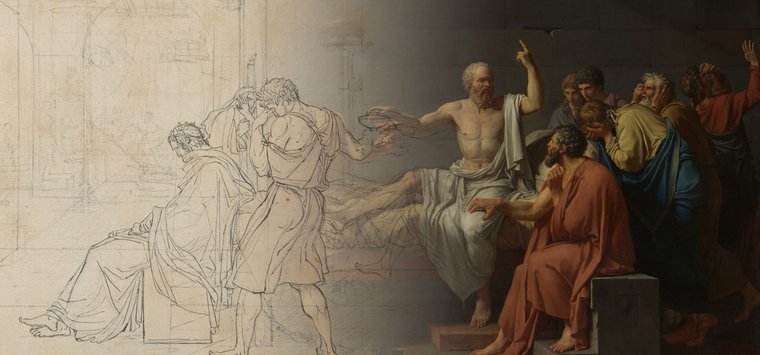
One of the adages I lived by in my twenties was “drunk words are sober thoughts.” It gets parroted constantly. Reddit’s r/relationships will invoke it any time a relationship is strained by something said six drinks in. And I don’t deny that drunk actions have lasting consequences that need sober repair. But I’ve started to wonder why we accept, almost on instinct, that the words said while drunk are the true ones.
The Romans had their own version, in vino veritas: in wine, there is truth. Sometimes the ancients used it the way we use the modern phrase. The Greek poet Theognis says wine shows a man’s mind the way fire tests gold. But they also used it to mean that wine lowers your guard and you spill your secrets. When Pliny the Elder brings up the saying, he’s in the middle of a list of what drunks blurt out: their secrets, the terms of their wills, the remark that gets their throat cut. The first meaning says alcohol reveals your soul, while the second says it reveals your secrets.
At some point, our version dropped the second meaning and kept the first. “Drunk words are sober thoughts” means you let the mask slip, which assumes there’s a mask in the first place and that you’re wearing it while sober.
Even the ancients who took the drunk word most seriously didn’t go that far. Tacitus says the Germans argued out their big questions at feasts on the theory that nobody totally plastered can fake anything. Then they took it all up again the next day, sober, and decided. Herodotus says the Persians wouldn’t act on anything serious until it had held up both drunk and sober.
So why shouldn’t the restraint count as part of the self? Say I’m struggling with my love life and my brother gets engaged to his longtime girlfriend. I feel envy and resentment deep down. Two versions of the night I get the news.
- Sober: I feel the envy and resentment, but then a second thought arrives: “I love my brother, and he deserves happiness.” The envy wanes as happiness floods in. I join the celebration; everyone has a great time.
- Drunk: I feel the envy and resentment. I start to break down. “Why can’t I find love? Why does everyone have good things happen but me?” The envy has spilled over and I’ve made a scene. I still love my brother, but my state has made a fool out of me.
Both envy and love are very real emotions that can coexist. The sober ego can choose which one it values more. The drunk id chooses the louder one.
When I drunkenly tell a near-stranger that I love them and that I’d take a bullet for them, that they’re the best person I’ve ever met, nobody calls that a sober thought. My wife goes, “Sorry, he’s a happy drunk.” (Very true!) But the impulse is a sober one. I wrote a blog post in 2015, stone sober, about how I love to tell my friends what they mean to me, especially when I’m drunk. Nobody says “drunk words are sober thoughts” to me then. Drunk affection gets discounted while drunk cruelty gets treated as revealing. The adage is really a theory about people being gilded: gold on the surface, cheap metal below.
Is the sketch more real than the painting because it’s raw?
I suspect the reason we keep picking the sketch has to do with the history of American faith. The adage isn’t uniquely American; Russian and Yiddish have their own versions. But it’s easier to trace a line from our history to the modern day.
Essentialism is the belief that a person is a fixed thing. They have an essence to them, and behavior just lets you peek at it. It’s probably a universal intuition; young children tend to see the world this way. Good people and bad people. The scorpion kills the frog because it’s in his nature. Nearly every major moral framework addresses this specifically by rejecting it. Aristotle said you become a good person by doing good things, the way you become a bricklayer by laying brick. Xunzi in China said that human nature is evil, and goodness is built through effort overcoming it. Judaism said that the heart follows the deed. The Catholic Church built a cathedral around forgiveness.
The Reformation is an exception because it was born in disagreement. The medieval Church held Augustine’s grace (which is given) alongside Aristotle’s habit (which is built). Martin Luther, an Augustinian friar, didn’t agree that they could coexist. In September 1517, shortly before his 95 Theses, he wrote a different set for debate at his university. One of them is an inversion of Aristotle’s line: we don’t become righteous by doing righteous deeds; we’re made righteous, and then we do them. The next one calls nearly all of Aristotle’s Ethics the worst enemy of grace. Three years later Luther had refined it: good works don’t make a good man; a good man does good works.
It was Calvin who took it to its limit. God had decided before time who was saved and who was damned. There was no trial; the verdict was handed down and you could not change it. Human nature was corrupt to its core. Any good in people, God had placed personally. So how do I know which list I’m on? How do I know which list my neighbors are on?
The Puritans decided to search for evidence. Good works couldn’t turn you into one of the elect, but they might be a sign that you already were. This led believers to anxiously police each other’s conduct for proof of a verdict they couldn’t see. If the damned are always going to be evil, why would I want them near my children?
Massachusetts Bay turned that anxiety into an institution. You could not vote unless you were a full member of the church, and you couldn’t become a full member until you allowed the congregation to judge you based on the story of your conversion. They listened, and then they voted on whether they believed you.
Deeds are treated as evidence, and evidence doesn’t come in sizes. A small slip, read as evidence, says as much as a big one. A society that spent over a century examining its own members for signs of hidden evil became a culture that examines its neighbors for signs of hidden evil.
That culture spread via the First Great Awakening. In the mid-18th century, a wave of revivals ran through the colonies. The two major players, Jonathan Edwards and George Whitefield, were Calvinists. The revivals spread the practice of searching for signs of grace from Massachusetts to Georgia. Decades before they became a single country, the colonies got a shared experience and the seeds of a habit.
Most Americans today couldn’t tell you what predestination means, let alone who Calvin was. The revivalists from the Second Great Awakening didn’t care for it. But they were still Protestants. The causal arrow still flows from “good people do good things” rather than the reverse. The revivalists believed fiercely in change, as long as it happened all at once. You were born again, fresh.
There’s an old Irish joke. A man says he doesn’t believe in God. “Fine,” comes the reply, “but are you a Catholic atheist or a Protestant atheist?” American culture is Protestant atheist. We believe that what a person does reveals who they always were, and that the face underneath is probably worse than the pretty mask they’re wearing. If change is possible, it’ll be all at once.
I was raised Catholic in a part of Texas where that’s the air everyone breathes, went to Catholic school from when I was three, spent my teenage years into my twenties as a secular materialist, and came back to faith by way of the existentialists. It’s a weird journey, but it gave me three perspectives on the same question. Like three genre-shifting covers of the same song: the same point, but expressed radically differently. Catholicism is straightforwardly Aristotelian: acts shape the soul. The existentialists say there’s no soul you can show in the first place until you’ve acted. Materialism got me there too, though it took a much weirder route. I couldn’t believe in a free will that was an exception to the physics of the universe, and I couldn’t believe there wasn’t free will, so I landed on compatibilism. My choices were determined at the start of time, but they’re still mine because I’m an incomplete subsystem. Those choices also feed back into whatever is doing the choosing. Which is just a science-y way of being a bricklayer.
My family fights. Often, and loudly. Screaming matches. Then Christmas comes, and New Year’s, or just a random Sunday, and we’re all there like nothing happened. I have fights with my friends and we get back together. I assumed everybody worked like this until I discovered the internet. A fight never became a vote on whether you still belonged.
I’ve screwed up a lot, and I still have good friends. At one point I had to tell my best friend the least flattering thing about me. She said, “I’m not friends with part of you. I’m friends with all of you.” That was a redemptive moment for me, but mostly it just felt like friendship. Maybe if I’d grown up further north I’d see it as having a distinct before and after. Nothing between us changed, except her support in my attempts to become a better man. The work happened everywhere else; I’d catch myself slipping into the habit and then humiliate myself by apologizing mid-sentence. Her grace was a special brick, the cornerstone. I still had to build the wall, and it was much easier to build thanks to it.
So when I tell you I have a friend who believes some things I find odious, you know which side of this I’ve been on. He believes them for reasons I understand and disagree with, and he is, apart from that, a great friend and a great dude. However, one by one, everyone else has cut him loose. I’m what’s left. They keep telling me to follow suit, that I shouldn’t have to carry this burden. And yeah, I get it. I shouldn’t have to. But somebody should pick up that burden, anyway. If not me, who? The only people left would be those who will pull him deeper and deeper.
The advice assumes that his beliefs reveal what he is. What he is, he’ll always be. By that logic, yeah, I guess I’m wasting my time trying to get a fig tree to make apples. But by the logic I was raised on, I can hold what he believes and who he’s been to me at the same time. I’m not friends with part of him; I’m friends with all of him.
That advice I got came from the same essentialism whose fingerprints are all over American life, in how we date, how we interact online, how we deal with criminals, and the stories we tell. Start with dating. You either “click” right away or you don’t. If a potential relationship takes work, it “isn’t meant to be.” Kind of an odd way of putting it, really. Meant by whom? Even the whole vocabulary of romance is predestination in a trench coat. “My girl and I are meant to be; she’s the one. She’s my soulmate; she was built for me.” What really drives it home for me is “the ick,” where a single unflattering moment outweighs months of good evidence. The ick is the soul underneath being revealed.
Online, a tasteless post from half a lifetime ago can be unearthed and treated as news. It doesn’t matter whether the author disavowed it, has grown since, or has advocated for the opposite. The old post is treated as a glimpse into their soul, and everything else is their attempt to bury their nature. Growth can’t count as evidence; it’s just fear of being discovered, because nobody changes slowly. The 2026 film The Drama is about exactly this.
Spoilers for The Drama (2026) 1 min
In the film, one of the protagonists confesses that the worst thing she ever did in her life was plan a school shooting. She was lonely and in pain, and ended up not going through with it. What’s more, she went on to spend fifteen years as an avid anti-gun activist. The rest of the film is about how that thought crime swallows everything else. The people in her life—the people that love her—can’t see her as anything but what she planned half her life ago, despite fifteen years of bricklaying. She’s treated as having shown her true essence, and her activism is written off as a cover for her true soul.
Our justice system does it, too. If crime reveals what someone is, reform is pointless and all that’s left is to contain or dispose of them. On paper, your debt is paid when your sentence is finished. In practice, you leave a felon. You are marked as one of the damned, and that mark follows you for the rest of your life into job applications, apartment leases, and sometimes even friendships. This isn’t hypothetical, either. One of my close friends is a felon, and it’s made me keenly aware of how many casual conversations involve pathologizing people whose debts to society were supposedly paid off.
Even our fiction isn’t spared. American stories are powered by the reveal and the turn.
The reveal is the twist where a character turns out to have been good or evil all along, and every one of their actions gets recontextualized as the mask they wore to serve their ulterior motives. The trope itself is old as dirt, but what Oedipus finds out in his reveal is a fact about who his parents are. It says nothing about who he is. It’s the same split between the soul and the secret.
The turn is what wrestling calls the heel turn (or its mirror image, the face turn). Either way, it’s a dramatic switch of sides that takes one scene. The villain turns in the last act just in time to die. Darth Vader gets a few minutes of being good, then dies. Nobody knows what a redeemed Vader does after the fall of the Empire, and frankly few care to know. When George Lucas went back to make the prequels, he made Anakin the Chosen One: born without a father, prophesied from the start, holding immeasurable potential and power. His fall became something done to him by the Jedi masters who failed him and the Sith who manipulated him, so he never really turned at all. His redemption was retconned into being a return to his essence.
Les Misérables is an odd case where you can see both the Catholic and Protestant kinds of redemption in the same story. In the novel, the bishop only starts Valjean’s journey. He immediately robs a little boy named Petit Gervais. When the boy runs off, crying, Valjean realizes what he’s done and searches for him. He can’t find him to give him the coin he stole, and breaks down openly weeping for the man he is. He spends the rest of the novel laying brick by brick, that guilt hanging over him as he tries to be the man he knows he could be. The popular versions cut the boy entirely. It’s a small omission that changes the whole story. The musical’s prologue was written for the 1985 West End production and has Valjean become a new man in a single song. The 2012 film keeps this version. He still takes responsibility for his actions, and nothing in Protestant theology says he shouldn’t, but compared to the novel the causal arrow is reversed. He is made a good man through the bishop, and the good works follow.
Our stories almost never show the slow change, the bricklayer. When a story shows it, people rave about it. Zuko’s arc in Avatar: The Last Airbender is still the standard example of redemption done right. The thing people praise about it is the slow burn: it took its time, he backslid, he was tempted, and he had to keep choosing it over and over. His betrayal of his father figure, Uncle Iroh, is forgiven by the audience because Zuko kept putting the work in. It wasn’t revealing, because the show made him a bricklayer.
I bonded with one of my best friends over a shared love of The Elder Scrolls V: Skyrim. Deep into the main quest, you climb the tallest mountain in the game and meet Paarthurnax, an ancient dragon, who asks you:
What is better? To be born good, or to overcome your evil nature through great effort?
The internet ran with it. People to this day keep posting it in every “most profound quote in gaming” thread, with hundreds of replies fawning over the philosophical depth.
It’s funny, because the question is old. Very old. Aristotle-wrestled-with-it old. The question should be so deeply worn into our culture that a dragon asking it would get an eye-roll, and not the standing ovation it got.
It sounded profound because the question had been mostly forgotten by us. Our culture had stopped treating the second option as real. “Overcome your evil nature through great effort” really means “cover up your evil nature through great effort” when you assume actions merely reveal your nature.
“Evil nature” isn’t hyperbole, either. He was Alduin’s lieutenant in the war that nearly wiped out humanity, and he has blood on his talons that no amount of meditation can wash off. But he also turned, taught humans the Voice that let them fight back, and has spent millennia on a mountaintop in a permanent blizzard, fighting against his own nature. He tells you that the temptation to revert to his nature is endless. That’s something most people agree with, Calvin most of all. Human nature is corrupt; the fight is about whether it’s a verdict. Shortly after you meet Paarthurnax, the Blades (the game’s dragon-hunters) demand that you kill him and refuse to help you until you do so. To them, he’s a dragon.
The game forces you to choose, and a lot of players refused. The quest became notorious, with players trying to find a way to speak reason to the Blades. Players wanted the Blades to recognize the change Paarthurnax had enacted, that he had overcome his nature as a dragon and was an asset now. This culminated in a popular mod that exists solely to give you the option. Players wanted them to recognize the painting so badly that they rewrote the game to pick it over the sketch. (I wouldn’t know. I never finished the main quest in the four hundred hours I played it.)
In 1935, two drunks from Vermont started an organization. Alcoholics Anonymous said that you’re never cured; you count your days instead. This quickly put it at odds with its evangelical roots, which preached complete victory over sin. A few years after its founding, a Jesuit turned up to tell co-founder Bill Wilson how much his Twelve Steps resembled St. Ignatius’s Spiritual Exercises. Wilson had never even heard of St. Ignatius.
When a tradition hides the bricks, we have to keep reinventing them. Every time we do, it feels like a new discovery, whether it’s Zuko or Paarthurnax or AA.
There’s a passage by C. S. Lewis I keep mulling over. In it, he’s answering the misconception that good people don’t know what temptation is like. His reply is that only the people who resist a temptation will ever find out how strong it is. You learn the force of the wind by walking into it, not by lying down. Someone who gives in quickly has no idea what the next hour would have felt like. Those who give in have, in a sense, led sheltered lives.
I want to push that image one step further. He’s talking about whether you stand or lie down, but the wind itself isn’t the same for everyone. Some people live entire lives in the breeze. Others wake up every morning in a hurricane. It doesn’t have to be their fault; it might be their temperament, or addiction, or history, or just the particular shape of temptation. I have zero interest in gambling, so avoiding it doesn’t make me more moral than someone with a gambling problem who runs into it in every other ad. The essentialist view doesn’t account for wind. It can’t. It can only record whether you’re on your feet or on the ground. So it will reliably rank me as more moral than the problem gambler who keeps relapsing but refuses to stay down, even though their fight is so much more difficult than mine. The fall tells you about the wind. The rise tells you about the soul.
What someone says six beers in tells you about the kind of thoughts they have in their head, influenced by the winds they face. The sober self, the one that’s supposed to be a mask, is the one that does the walking. It’s also the one that has to apologize in the morning. So when someone we love says something ugly, we have more choices than just casting them off.
Paarthurnax never actually answers his question. Not with words, anyway. He answers it every morning, when he wakes up in a blizzard and stands in it for yet another day. He’s one day closer to the next milestone.