I left the Catholic Church at twelve. I was obsessed with physics, but couldn’t understand how a universe where particles behave predictably was compatible with the God I grew up with. I had a crisis of faith and talked to a priest. I’m not really sure what I was expecting, but I remember being told that it wasn’t a sin to use God’s gift of reason to explore the universe, wherever that took me. So I went.
The only real contact I had with atheists at that point was with the ones online: the ones who left with conviction. They cited Dawkins and Hitchens, church scandals, the cruelty of the religious people in their lives. The religious said people left the church due to moral rot. The secularists agreed.
It surprised me, though, that most of the secular people I met in real life weren’t passionate about it. They were casual atheists; God didn’t really do anything for them. It wasn’t a crisis of faith, a possession by the devil, drugs, or forbidden knowledge. It was just… indifference. How do you become indifferent to the creator of the universe?
I think the answer is that for most, the faith they inherited had already atrophied long before it got to them. If your parents only went to church out of habit, it was just an annoyance and a waste of a couple of hours. The fall of faith isn’t a sudden rebellion; it’s the logical conclusion of a shift that happened two or three generations ago.
Humans need to have reasons for everything, and we really like stories. Put those two together and you have the idea that theism arose from using God to fill in the blanks: why the sun rises, what lightning is, how we got here. Science then put God out of a job. That’s how the story goes, anyway.
I think it’s a decent reason why theism exists, but I don’t think that explains religion. The questions that drove humans to their knees weren’t about the nature of physics; they were Book of Job questions.
In the Book of Job, a good man loses his livelihood and all ten of his children in a single day, and then his health. His friends show up offering an eerily modern version of religion: God has a plan, you must somehow deserve this, apologize and move on. Job refuses and demands the Almighty show up and explain Himself. He yells at the sky. When God finally answers out of a whirlwind, He doesn’t explain anything. He asks where Job was when the foundations of the earth were laid, and Job backs down. But then God turns to Job’s friends and tells them He is furious with them. God preferred the man screaming into the void to the men reciting theology.
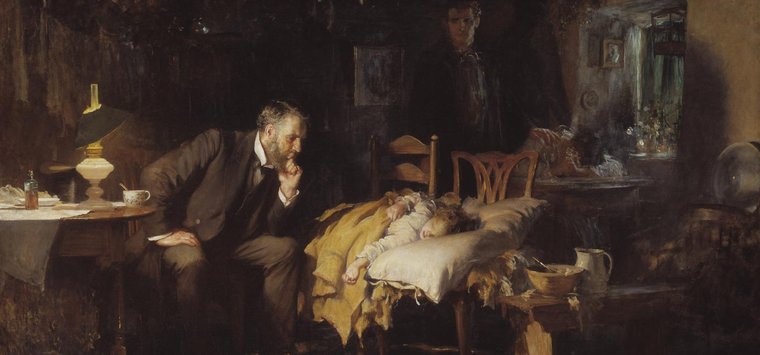
For almost all of human history, Job was the baseline of daily life. Roughly a quarter of all infants died before they turned one, and nearly half of all children died before reaching adulthood. There are graveyards we can see today where seven small headstones sharing a last name all have similar dates on them. Who do you yell at but God? You scream at Him, you bargain with Him, you hate Him, and you beg Him again the next time your precious child starts coughing. You cannot be indifferent to someone you’re fighting with.
What stopped the fight wasn’t Darwin or Einstein. It was penicillin, clean water, vaccines, germ theory. Small graves became rarer. Children who remembered losing neighbors and siblings grew up to become adults who never had to bury a child. When my kid gets sick, I don’t have to pray to God that I get to see him again tomorrow. I drive to a pharmacy, pay twelve bucks for amoxicillin, and play with his hair as he relaxes in bed.
Modern medicine and prosperity didn’t disprove God; they made it so you didn’t have to fight Him at every turn.
There’s a name for this: existential security. You can pretty reliably predict how secular a nation’s inhabitants are by how comfortable they are. Rich countries are much more secular than countries where small graves are still being dug.
Modern secularism is completely rational on that view. If you think of religion as a strong medicine like chemotherapy, it makes a lot of sense. When humanity was living through the brutish state of nature, the medicine’s side effects were a price people were willing to pay to keep from soul death when they dug a third tiny grave.
Today, most of us don’t live under that threat. Why would you need to take medication with strong side effects if you don’t feel sick? Smart, secular people look at religion and see scandals, bad politics, hypocrisy, cruelty, and lack of reason. They aren’t being blind or irrational; they are being entirely sensible. If your life is safe and functional without the supernatural, why on earth would you want the side effects?
When Nietzsche wrote “God is dead. God remains dead. And we have killed him,” he gave those words to a madman who runs into a marketplace holding a lantern in broad daylight. The people, the everyday atheists, just laugh at him and ask if God got lost like a child.
The madman responds seriously: by killing God, we’ve made ourselves the only candidates to be God. We have lost the moral fabric binding society. “Unchained this earth from its sun,” as he put it. The crowd stops laughing. He smashes his lantern and says he has come too early. Light takes time to reach the earth, and the sun’s disappearance is traveling through space still. They see the sun, but it’s gone. God is dead.
Nietzsche was right that something died, but the sun still shines. The era that marked the rise of secularism also eradicated smallpox. The sky didn’t fall; we haven’t devolved into the state of nature. I’d even argue that society is more moral now than it’s ever been. You might say, “Okay, sure, but if the light is out we’re using the last of our warmth. Decency is decaying, just slower than faith.” I think people becoming more moral doesn’t really fit that, though. The crowd was right. It turns out you can kill God and enjoy the weather. There’s nothing irrational about shrugging at metaphysics and having a laugh with your friends.
I came back to faith in my twenties anyway. I stuck with that priest’s advice to follow reason wherever it took me, and eventually strict materialism stopped being the obvious answer.
Physics is beautiful, which is why it convinced me at twelve that the universe was the most majestic clock. But what it can’t explain is why it feels like something to be the person watching the particles. When I ran into the hard problem of consciousness—the undeniable fact of first-person subjective experience—the clock stopped looking like a complete explanation.
I tried to fill the gap! I read the best-known of the materialists—one of the Four Horsemen of New Atheism, Daniel Dennett—who argued that consciousness is essentially a user-illusion created by the neurochemistry in the brain. Okay, but an illusion is still an experience. If it only seems like I’m in pain, it still hurts.
Rejecting strict materialism doesn’t mean Rome is the center of faith and the pope is the Vicar of Christ. (Checkmate, atheist!) There are plenty of alternatives for atheists. Panpsychism, which treats consciousness as a fundamental property of the universe like mass or charge, is particularly fascinating to me. Strict materialism doesn’t have a clean answer to everything. Neither does religion; God never did tell Job why. For an atheist, that doesn’t really matter: you don’t need the answer to why we’re conscious to live a good life. Part of being an atheist is being okay with not having answers to everything.
Once reason led me to conclude that no belief could close every gap on the chalkboard, I felt free to choose which gap I wanted to live with. I chose faith. But the god of the gaps doesn’t inspire awe. It’s a placeholder.
What made God real to me was the will.
Let’s take the burning monk. In 1963, Thích Quảng Đức sat in the lotus position, let another monk pour gasoline over him, set himself ablaze, and burned to death without moving or making a sound. The irony isn’t lost on me: he was a Buddhist protesting a Catholic government via a method the Church condemns. I still consider him to be the pinnacle of will. He didn’t move a muscle as his skin turned to ash, in service of a duty he believed in. Billions of years of evolution built him to react, to try and save himself, to do something. He did not. His mind overruled everything and his body did nothing.
That doesn’t prove the mind exists outside of matter. But the bottom-up story of particles behaving predictably does have to come up with an explanation, and many of the ones I’ve seen sound like epicycles to me. A strong belief about what he ought to do decided whether a muscle twitched. I couldn’t stop thinking about how powerful that ought was. I still can’t.
Hume’s guillotine says no amount of is will give you an ought. It doesn’t matter how many facts of the world you stack together, or how intricately you arrange them—they still can’t tell you how the world should be. But oughts clearly exist. Tell a parent at a third tiny grave that their this should not have happened is just a mood. That parent is right, and if you can stop the next child from dying then you ought to.
I couldn’t tell that parent their should didn’t exist, and I couldn’t build it out of is. Consciousness didn’t help here, either. I couldn’t make myself believe oughts came from nowhere. No other creature in creation interacts with them. Why do we? I chose to believe their source is God.
It’s the madman’s argument run backward. He said that if God is dead, the moral fabric goes with Him. I think that’s accurate. But the moral fabric is still there, and the sun still shines. So whatever we killed, it wasn’t the source of all oughts. I think what died was the fight. Following oughts doesn’t require reckoning with where they came from. The crowd gets by fine every day… I just needed to know.
A god that just exists as a placeholder is an explanation. A God who is the source of every ought is someone you answer to and demand answers from. He’s someone you yell at, the way Job did, when the world isn’t what it ought to be.
I didn’t come back looking for structure, or a neat set of rules I could follow without thought to go to heaven. I came back to the Franciscan side of the Church, the side that says the gift of will comes before the gift of reason: my choice matters more than my intellect. I remain opinionated and disagree plenty with the Church, but I admire the focus on penance. Catholicism doesn’t tell you what you are and leave you there. It gives you an ideal to strive for, tells you there is work to be done, and gives you the room to keep building toward it. You have the freedom to become what you want to be, and you have a safe harbor for when you inevitably screw up. God stays hidden to leave that up to you. I think the priest who let a twelve-year-old walk out on faith knew that a faith you aren’t free to leave isn’t freely held. So I went back.
I’m a dad; I love seeing my son’s smile and being relatively certain that he’ll get to be seventy years old, with grandkids of his own, and still my baby. By making the world safe, we made God optional. It means that for some of us, the reverts and converts of the world, choosing to believe is entirely our own fault.